
Rand Weakens to R16.38 as US PCE Data Looms
September 30, 2026Rand Dollar Exchange Rate: R16.57 as Fed Hike Bets Fade
October 7, 2026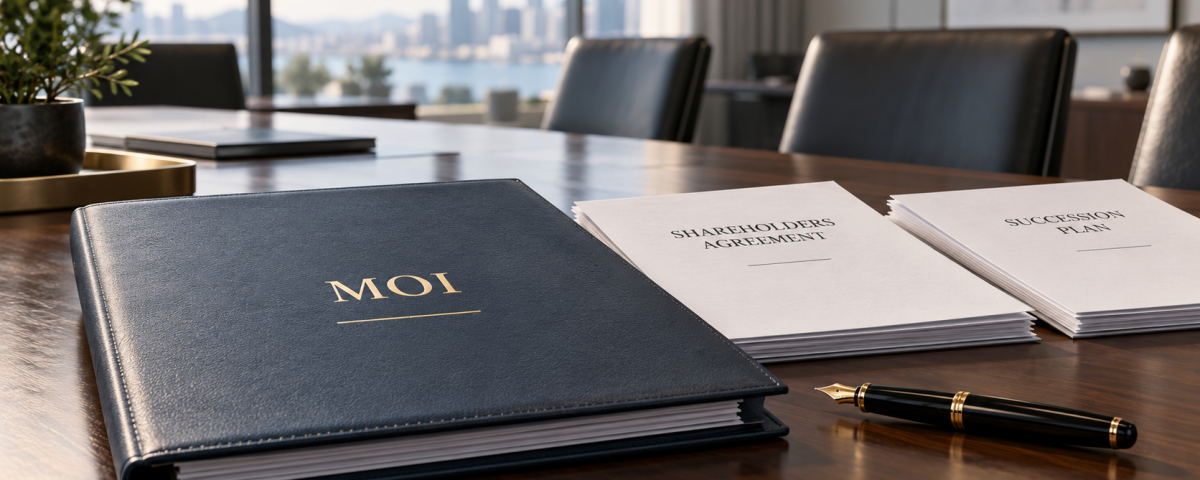
Know what your founding documents say — before a dispute tests them.
Two Documents, One Company: Why Your MOI Isn’t Enough
When business partners fall out, the fight is rarely decided in the boardroom. It is decided years earlier, by two documents most founders sign in a hurry and never open again: the Memorandum of Incorporation and the shareholders agreement.
Picture a founder who built a company from a warehouse and a handshake. Twenty years on, his late partner’s children want their inheritance valued, and he wants to keep control. Both sides reach for the founding documents, hoping they say something they don’t.
Often there is only a standard-form MOI, adopted in an afternoon at incorporation. There is no shareholders agreement at all. And what happens next depends almost entirely on the default rules of the Companies Act, not on anything the partners ever agreed.
The MOI: the company’s public constitution
The Memorandum of Incorporation is the founding constitution every company must have under the Companies Act 71 of 2008. It replaced the old memorandum and articles of association with a single document, filed with the Companies and Intellectual Property Commission (CIPC).
Section 15(6) makes the MOI binding between the company and its shareholders, and on its directors and officers. It binds every shareholder automatically, including anyone who buys shares later. It also decides many of the Act’s “alterable provisions”, the default rules that apply unless the MOI says otherwise.
The catch is that the MOI is a public document. Once filed with the CIPC, anyone can request a copy: competitors, creditors, journalists, a future counterparty. That makes it the wrong place for the commercially sensitive detail of the deal between shareholders.
The shareholders agreement: where the real deal lives
The shareholders agreement is the key document for how the owners of a company actually work together. It is a private contract between the shareholders, and often the company itself. It is not filed with the CIPC and is not available to the public.
Because it stays confidential, it is where shareholders record the terms they would never want on a public register:
- how shares are valued when someone exits, dies or is bought out
- what happens when equal shareholders deadlock
- funding obligations, dividend policy and who may appoint directors
- good leaver and bad leaver terms, restraints of trade and confidentiality
- drag-along and tag-along rights on a sale of the company
- how disputes are resolved, often by private arbitration rather than in open court
The trade-off is that a shareholders agreement binds only the people who sign it. A new shareholder is not bound unless they sign a deed of adherence, which is why the agreement and the MOI need to work together.
Why you need both, and why they must agree
Section 15(7) of the Act allows shareholders to enter into any agreement with one another about the company. But that agreement must be consistent with the Act and the MOI. Any provision that conflicts with the MOI is void to the extent of the conflict.
In practice, the MOI wins. A carefully negotiated shareholders agreement can be undone by a standard-form MOI that says something different, or that never switched off a default rule the agreement relies on.
| Memorandum of Incorporation | Shareholders agreement | |
|---|---|---|
| Required by law | Yes, every company | No, but strongly advisable |
| Public or private | Public, filed with the CIPC | Private and confidential |
| Who it binds | Company, all shareholders, directors | Only the parties who sign it |
| New shareholders | Bound automatically | Bound only by signing a deed of adherence |
| If they conflict | Prevails | Void to the extent of the conflict |
The usual approach is to keep the MOI lean but aligned. It carries the provisions that must bind the company and every future shareholder, and it switches off or alters the defaults the deal depends on. The shareholders agreement carries the commercial detail, privately.
When the silence gets expensive
In Van der Watt v Schoeman and Others [2024] (ECGq), two doctors ran their practices through a company they owned 50/50, and were its only two directors. After relations soured, one stepped back from the practice but kept her shares and her seat. The other began acting for the company without board approval and ignored her requests for a board meeting.
With no agreed way to break the deadlock, she had to apply to the High Court under section 163 of the Act, which gives relief against oppressive or unfairly prejudicial conduct. The court granted her relief, but only after litigation that a deadlock clause and an agreed exit mechanism could have avoided.
The cost of silence: The Act offers no built-in buy-out for deadlocked shareholders. Its fallbacks are a section 163 application or, under section 81, asking a court to wind up a solvent company because the shareholders or directors are deadlocked. Both are slow, expensive and public. A well-drafted shareholders agreement, backed by a consistent MOI, keeps that decision in the owners’ hands.
Questions to ask about your own company
If your two largest shareholders stopped agreeing tomorrow, would your documents say what happens next? A quick check:
- Do you have a signed shareholders agreement, and has every current shareholder signed it or a deed of adherence?
- Is it consistent with your MOI, or are you still on the standard form adopted at incorporation?
- Does your MOI switch off or alter the defaults your agreement relies on, such as director appointment rights or voting thresholds?
- Is there a deadlock mechanism and an agreed method for valuing shares on exit?
- Do the documents cover death, divorce, incapacity and a shareholder who simply wants out?
- If you hold interests through a foreign holding company, do the documents at each level of the structure line up?
- When were they last reviewed against how the business actually runs today?
The documents nobody reads
The MOI sets the public rules every shareholder must live by. The shareholders agreement records the private deal that makes those rules work for the people who built the company. Neither does the job alone, and a conflict between them is resolved in favour of the MOI.
If you don’t write the rules, the Act writes them for you, and it doesn’t know what you actually agreed.
Do your documents say what you think they say?
Speak to one of our attorneys about your company’s MOI and shareholders agreement before a disagreement tests them.
Speak to a Quattro AttorneyTrusted sources and useful links
© 2026 Quattro Group. This article is general information and not legal advice. For advice on your company’s MOI or shareholders agreement, speak to one of our attorneys.